When relaxing the just trained shoulders, the shoulder cable exercise is one of the most key gears of any gift training. This exact exercise is another superb one for working the shoulder muscles and has added advantages that may help recover the strength of the entire body’s upper portion. In this article, we will understand more about the shoulder cable exercise, ranging from the advantages of the exercise and how to do it correctly to how to integrate the exercise into a training program.
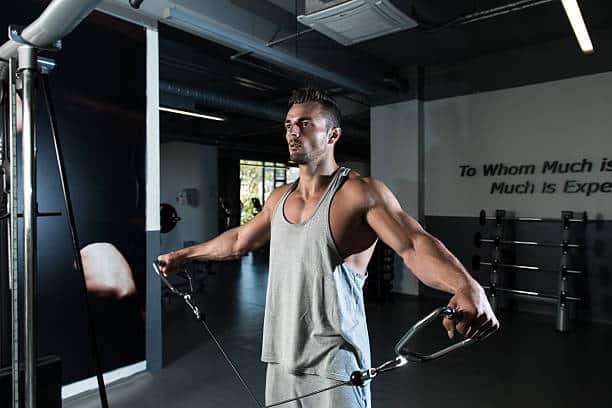
What is Shoulder Cable Exercise?
Cables Shoulder Cable Exercises are done using a cable engine, which provides vast wave and can be fixed at various fights. In this machine, weights and easily fixed pulleys offer resistance throughout the entire range of movement, which is very useful for strength training in the shoulders.
Unlike free hefts, which rely on gravity to provide fight, cable machines offer a unique advantage: they apply endless pressure on the muscles, which could lead to better muscle visit and growth. This constant tension is chiefly helpful when acting shoulder tests since one can carefully select and control the kind of fight required to target certain muscles.
Benefits of Shoulder Cable Exercise
1. Enhanced Muscle Engagement
There is no argument that one of the advantages of Shoulder Cable Exercises is that one can keep the tension on the shoulder muscles constant throughout. The Cable exercise is different from the free-weight dumbbell exercise or barbell exercise, in which momentary resistance is greatly variable throughout the point of range of motion until contraction. This may enhance other muscle activities and promote muscle development in the long run.
2. Improved Shoulder Stability
The stability is important for issues related to the shoulder and the athlete’s overall. It also helps to increase Shoulder Cable Exercises to develop stability by isolating the minor stabilization muscles around the shoulder joint. It also assists in providing a greater level of stability that not only aids in averting injuries but is also beneficial in other strength training movements concerned with the shoulder and your overall functional movement.
3. Versatility and Variety
Cable machines have distinctive changes and accessories in their setup; hence, they provide numerous numbers. When it comes to shoulder exercises, you can do lateral raises, front raises, reverse flies, and many others to work different parts of the shoulder and avoid monotony. This versatility helps avoid workout plateaus and instead stimulates the muscles uninterruptedly.
4. Controlled Movement
More to do with Shoulder Cable Exercises is their efficiency and flexibility regarding movements. What makes a cable machine rather unique is that it enables you to do your reps and sets with very good form to avoid injuring yourself and to ensure that you are targeting the right muscles. This controlled movement is handy for beginners, especially those needing the correct form of exercise.

How to Perform Shoulder Cable Exercises
1. Shoulder Cable Lateral Raises
Shoulder cable lateral raise can be easily classified as one of the best movements that work on the lateral deltoids, the muscles that shape shoulder width.
Steps:
- Adjust the pulleys of the cable machine to the smallest hole on the cable machine.
- Stand in front of the steamer with your back towards the machine and grasp the handle with one hand.
- With the elbow pointed upwards, maintain your arm in this place, raising the handle to the side until it is perpendicular to the floor.
- Gradually bring the handle back to the initial position at the top of the chest area.
- It is repeated for the desired number of repetitions, and then the exercise is done by switching arms.
2. Shoulder Cable Front Raises
Front raises mostly focus on the anterior deltoid muscles needed to compound the strength and vascularity of the shoulders’ frontal sections.
Steps:
- Move the cable machine pulleys as low as possible or possibly to the floor level, depending on the user’s height.
- Facing the machine, hold the handle with one of your hands.
- Do this while maintaining your arm’s straight position; bring the handle up to your body so that your arm is alongside your body.
- This is done in the same style as bringing the handle down, and then the handle is placed back in the starting position.
- Complete the intended repetitions before moving to the other limb involved in an exercise.
3. Shoulder Cable Reverse Flies
Another complex that works on posterior deltoids and the upper back is reverse flies, which help to strengthen the shoulder girdle and enhance balance.
Steps:
- Adjust the pulleys of the cable machine to the highest position.
- The position for starting is with the back towards the machine and each handle in the palm of one of your hands.
- Leaning forwards at the hips, ensure your back remains Parallel to the floor.
- Your elbows should remain slightly bent. With this view, sweep the handles to the left and to the right until the movement feels similar to having your arms parallel to the ground.
- Lift your hands to shoulder level, slowly return to the initial position, and do it again.
Tips for Effective Shoulder Cable Exercises
Maintain Proper Form: Shoulder Cable Exercises should do the above exercises in the right form to gain the full benefits of the exercises with little or no risks of injuries. Make slow and deliberate movements and avoid using too much weight, which may cause you to strain your muscles.
- Adjust the Weight Appropriately: Start with the amount of weight you will be able to use in the exercise with little strain, and then, as you build up your muscle strength, add weight.
- Incorporate Variations: To avoid routine exercises and train the different shoulder muscles, include different Shoulder Cable Exercises in your routine.
- Focus on Mind-Muscle Connection: Focus on the target areas to maximize the muscles being worked by the specific exercise.
Conclusion
The Shoulder Cable Exercise is a worthy addition to any training routine. It has several advantages, including better muscle activation and shoulder support, increased flexibility, and smoother and more controlled movements. This way, Shoulder Cable Exercises can be a helpful addition to your training since they help to develop the shoulder muscles more and with less danger of an injury. Maintaining a good posture, adding or reducing the load, and trying different exercises to make the workouts interesting and useful are also important. Therefore, through perusal, commitment and discipline Shoulder Cable Exercise they aid in achieving fitness goals besides improving overall strength and performance.
FAQs
Q1. What muscles do Shoulder Cable Exercises target?
Ans: It’s mostly future for the deltoid muscles, which are made up of the front, lateral, and post-images of each slice of the rear deltoids. As with any other exercise, liable on the type of exercise you do, you can target one or many other parts of the shoulder belt in order to gain proper part in muscle growth.
Q2. How often should I do Shoulder Cable Exercises?
Ans: To get the chief aids out of Shoulder Cable Exercises, do the exercise at least twice or thrice a week. Make sure that you have ample rest between your tests to help develop muscle mass. Recall to do exercises on the other muscles of the body to avoid strain too much on the shoulders.
Q3. Can beginners do Shoulder Cable Exercises?
Ans: Of course, novices are also capable of performing Shoulder Cable Exercises. While using weights, the initial steps involve using low weights and concentration to ensure that one performs the activity in the right manner. This should be done progressively as the body builds up strength and masters the technique to be used.